INDIVIDUAL EQUITY AND SOCIAL ADEQUACY IN THE U.S. SOCIAL SECURITY SYSTEM

Link: https://actuary.org/wp-content/uploads/2011/09/retirement-monograph-IESA.pdf

Graphic:
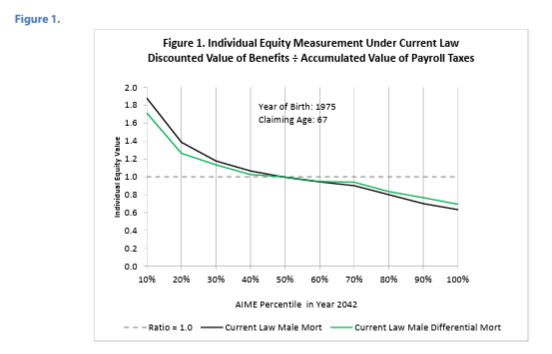
Excerpt:

These three features are sometimes characterized by the terms “universality” and “earned right.” Universality means that Social Security covers nearly all workers, across the entire earnings spectrum and everyone contributes toward those benefits at the same rate. The fact that even the very wealthy receive Social Security helps prevent benefits to the less well off from being stigmatized as welfare payments. Earned right means that a worker’s entitlement to a Social Security benefit derives from the worker’s employment and from the payroll taxes paid on earnings rather than from financial need. Together, the concepts of universality and an earned right to a benefit distinguish the program from needs-based programs such as Medicaid and SNAP (Supplemental Nutrition Assistance Program, formerly known as Food Stamps), thereby contributing to more widespread and enduring public support for Social Security.

….

Both individual equity and social adequacy are essential to the success of Social Security, by sustaining public support, and by providing a minimum level of income for covered workers and eligible family members. The mix of features that make up the program represents a trade-off between the principles of individual equity and social adequacy. The resulting balance has changed as the program has evolved. For example, spouse, survivor, and disability benefits, as well as benefits for non-spouse family members, were added and expanded at various times over Social Security’s history. The last amendment to the Social Security Act that resulted in a material benefit change was adopted in 1983. There is no theoretically correct balance between individual equity and social adequacy in Social Security. The current mix is the product of many legislative compromises that are incorporated into the current version of the Social Security Act.

Author(s): The Social Security Committee, which authored this monograph, includes Sam Gutterman, MAAA, FSA, FCA, FCAS, HonFIA, CERA— Chairperson; Janet Barr, MAAA, ASA; Gordon Enderle, MAAA, FSA; Iris Kazin, MAAA, FSA, FCA, EA; Eric Klieber, MAAA, FSA; Brian Murphy, MAAA, FSA, FCA, EA; John Nylander, MAAA, FSA; Larry Rubin, MAAA, FCA, FSA; Jeffery M. Rykhus, MAAA, FSA; and Joan Weiss, MAAA, FSA.

Publication Date: last updated April 2024, accessed 8 July 2026

Publication Site: American Academy of Actuaries, actuary.org
Global AI Adoption in 2025 A Widening Digital Divide

Link: https://www.microsoft.com/en-us/research/wp-content/uploads/2026/01/Microsoft-AI-Diffusion-Report-2025-H2.pdf

Graphic:

Excerpt:

To track this trend, we measure AI diffusion as the share of people worldwide who have used a generative AI product during the reported period. This measure is derived from aggregated and anonymized Microsoft telemetry and then adjusted to reflect differences in OS and device-market share, internet penetration, and country population. Additional details on the methodology are available in our AI Diffusion technical paper. [1]

No single metric is perfect, and this one is no exception. Through the Microsoft AI Economy Institute, we continue to refine how we measure AI diffusion globally, including how adoption varies across countries in ways that best advance priorities such as scientific discovery and productivity gains. For this report, we rely on the strongest cross-country measure available today, and we expect to complement it over time with additional indicators as they emerge and mature.

Author(s): AI Economy Institute

Publication Date: January 2026

Publication Site: Microsoft

Mapped: AI Adoption Rates by Country

Link: https://www.visualcapitalist.com/ai-adoption-rates-by-country/

Graphic:

Excerpt:

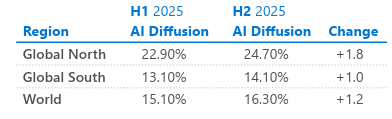
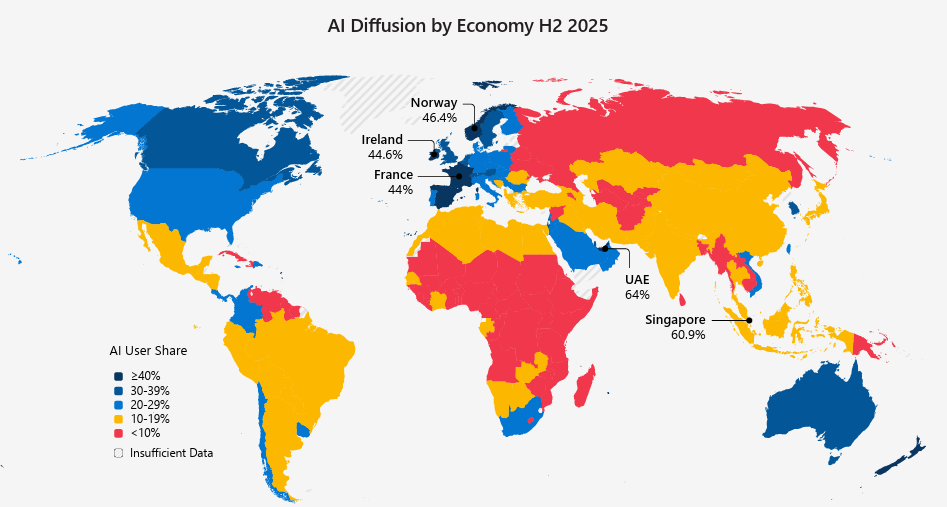
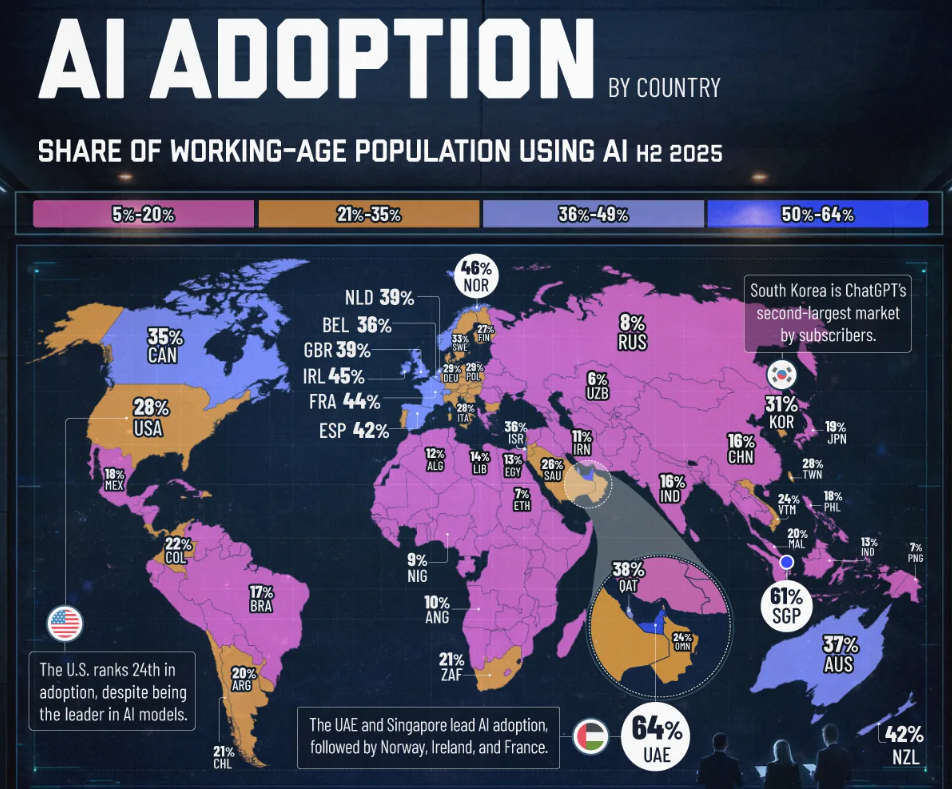
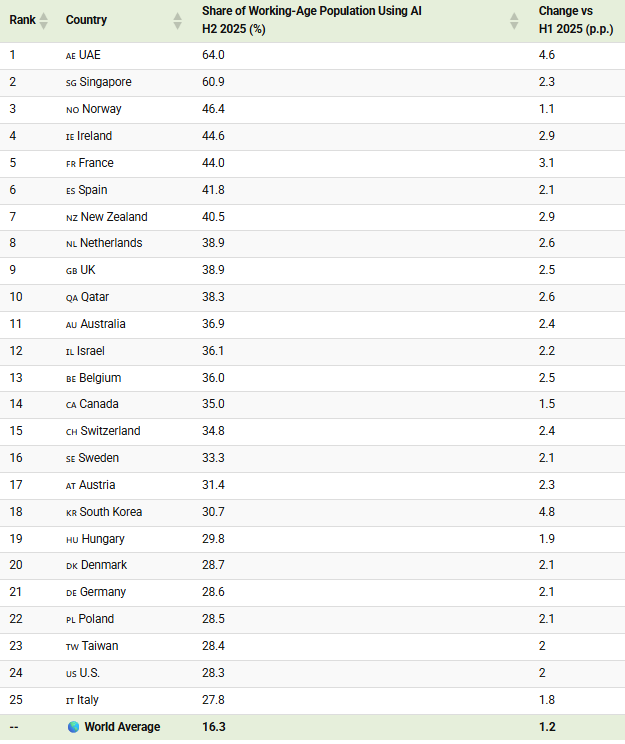
In the second half of 2025, 16.1% of the global working-age population used AI, indicating substantial room for further adoption.

At the same time, usage varies widely across countries. Adoption rates average 24.7% in the Global North, while they are 14.1% in the Global South. Key countries stand as clear regional outliers including the UAE and Singapore.

This graphic shows AI adoption by country, based on data from the Global AI Adoption in 2025 report from Microsoft.

Author(s): Dorothy Neufeld

Graphics by: Sam Parker

Publication Date: 22 Jan 2026

Publication Site: Visual Capitalist

Two Years In, Golden Gate Bridge Suicide Prevention Nets Have Almost Completely Eliminated Bridge Suicides

Link: https://sfist.com/2026/01/20/two-years-in-golden-gate-bridge-suicide-prevention-nets-have-almost-completely-eliminated-bridge-suicides/

Excerpt:

In their second year since completion, the Golden Gate Bridge suicide prevention barriers allowed only four suicides in the first half of 2025. In the second half of 2025, the bridge saw zero suicides.

For decades, it was an irresistable magnet for those at the end of their ropes. There was an average of 30 successful suicide attempts each year from people jumping off the Golden Gate Bridge, and an estimated 2,000 such deaths since the bridge opened in 1937.

Back in 2014, the Golden Gate Bridge, Highway and Transportation District approved installing suicide prevention nets on the bridge in hopes of ending this dark phenomenon. And while the installation of those suicide nets took years longer than planned and went about $150 million over budget, the barriers were finally completed almost exactly two years ago, and are proving their worth.

We now have our statistical results for 2025, which would be the first full year of the barriers being in place. And the New York Times reports there were only four Golden Gate Bridge suicides in the first half of 2025, and then zero suicides between June and December 2025. The Times adds that “seven months might be the longest stretch without a suicide at the bridge, though early records are sparse.”

We must throw some cold water on this assessment and admit there has reportedly been one successful suicide at the bridge in the first 20 days of 2026. But given this historical average of 40 suicides annually, and only four in the entire year of 2025, the barriers certainly appear to be doing their job.

Author(s): Joe Kukura

Publication Date: 20 Jan 2026

Publication Site: SFist